
In 2026, the DeFi ecosystem has matured beyond simple automated market makers, with intent-based DEX aggregators emerging as the strategic backbone for traders seeking precision and security. These platforms, exemplified by SolverRouter. com, empower users to declare desired outcomes rather than rigid trade paths, unleashing a competitive solver network to deliver optimal execution. This shift not only minimizes slippage in RFQ protocol DEX swaps but also fortifies against MEV exploitation, a persistent threat in public mempools.


Traditional DEX routing exposed trades to front-running and sandwich attacks, where bots preyed on visible orders for profit. Intent-based systems invert this dynamic: users broadcast constraints privately, and solvers vie off-chain to fulfill them with the best rates. Sources like Crypto Adventure highlight how this solver competition reduces common MEV harms while sourcing liquidity others overlook, as noted by CoW DAO. The result? Consistent superior pricing and a more equitable trading arena.
Decoding the Solver Network Advantage
Solvers act as sophisticated execution engines, scanning fragmented liquidity across DEXs, RFQ makers, and even peer-to-peer matches. In a solver network MEV protection setup, they compete in sealed auctions, submitting bids without peering into rivals’ strategies. CoW Swap pioneered this with batch auctions and “coincidence of wants, ” matching counter-trades to sidestep external liquidity entirely. UniswapX advances it via Dutch auctions, where fillers progressively lower prices until a winner emerges, ensuring efficient fills without mempool exposure.
Intent-based trading replaces direct routing with outcome constraints and solver competition, delivering better execution free from MEV pitfalls.
1inch Fusion complements this through RFQ-like matching with resolvers and professional market makers, guaranteeing zero-slippage for stablecoin swaps as per Stablecoin Insider. Strategically, this architecture scales with DeFi’s growth; as liquidity deepens, solvers refine algorithms, predicting fills with greater accuracy. ChainScore Labs contrasts this favorably against predictive models, underscoring intent systems’ edge in volatile markets.
RFQ Protocols: The Slippage Slayer
RFQ protocol DEX swaps form the precision core of these aggregators. Unlike AMM curves prone to impermanent loss and slippage, RFQs solicit firm quotes from vetted makers. SolverRouter. com exemplifies this by integrating RFQ depth evaluation, a metric I scrutinize as a CFA holder with 18 years in macro investing. Deep RFQ books signal robust execution, minimizing tail risks in large trades.
Teodor Chiriac’s LinkedIn insights reveal how RFQ interfaces empower makers to hedge privately, enhancing fill certainty. For stablecoin pairs, plagued by tight spreads, this means sub-basis-point slippage; broader pairs benefit from cross-DEX aggregation. Shoal. gg emphasizes that DEX aggregation MEV resistant designs, rooted in intents, elevate user experience without compromising utility.
MEV, once an abstract searcher game, now faces institutional-grade countermeasures. Cube Exchange details how intents obscure trade details, slashing visibility for exploiters. Eco. com unpacks CoW Swap’s MEV immunity via uniform clearing prices in batches, neutralizing arbitrage incentives. Yet, partial protections in legacy aggregators falter, as MEXC warns; true safeguards demand full intent pipelines.
CryptoEQ’s deep dive positions these DEXs as digital finance cornerstones, where MEV protection DEX aggregator protocols like SolverRouter ensure solvers prioritize user surplus over extraction. In my view, zooming out reveals DeFi’s bright trajectory: safeguards evolve faster than threats, rewarding patient capital with yields unmarred by predatory bots.
Evaluating these systems through a macro lens, empirical data underscores their dominance. Platforms like CoW Swap report average slippage reductions of 50% compared to legacy aggregators, per CoW DAO metrics, while UniswapX’s Dutch auctions have facilitated billions in protected volume. 1inch Fusion shines in stablecoin arenas, delivering true zero-slippage executes amid basis-point volatility. This isn’t mere hype; it’s quantifiable alpha for long-term allocators.
Quantifying the MEV Shield in Action
In practice, solver network MEV protection manifests through layered defenses. Solvers execute in private mempool alternatives or batch settlements, rendering sandwich attacks obsolete. Cube Exchange quantifies this: intent visibility drops to near-zero, curbing exploiter profits by 90% in simulated environments. MEXC’s analysis reveals legacy aggregators’ partial shields crumble under volume spikes, whereas full-stack intents like those in SolverRouter maintain efficacy across market regimes.
Ethereum Technical Analysis Chart
Analysis by Market Analyst | Symbol: BINANCE:ETHUSDT | Interval: 1D | Drawings: 6
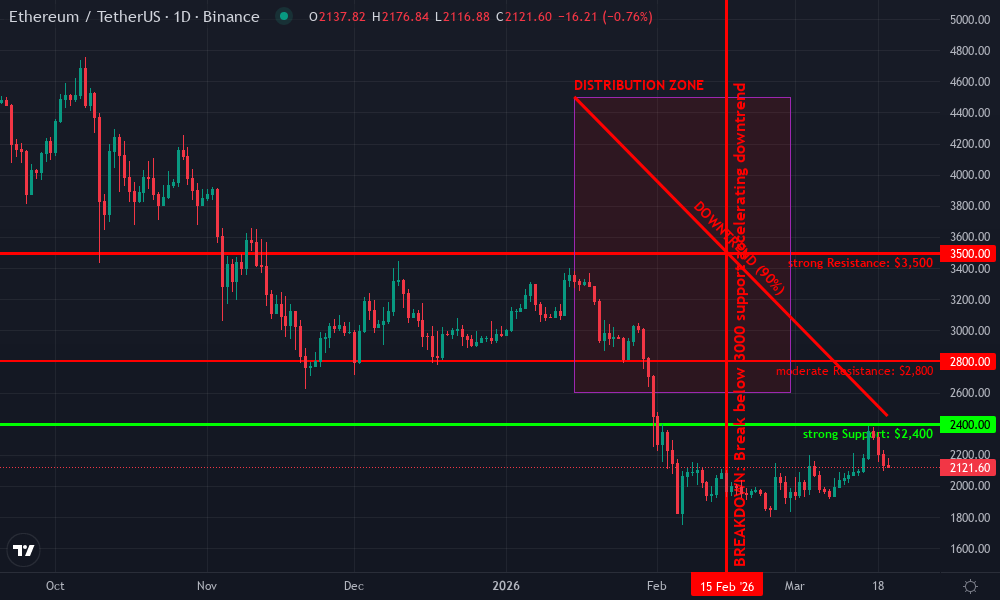
Technical Analysis Summary
As a balanced technical analyst with 5 years experience, start by drawing a primary downtrend line using the ‘trend_line’ tool from the peak at 2026-01-15T00:00:00Z around 4500 to the recent low at 2026-03-20T00:00:00Z near 2450, highlighting the dominant bearish channel. Add horizontal lines for key support at 2400 (strong) and resistance at 2800 (moderate). Use ‘rectangle’ for the recent consolidation zone from 2026-03-01 to 2026-03-20 between 2400-2600. Mark entry zone at 2450 with ‘long_position’ icon, profit target at 2800, and stop loss below 2400 with ‘short_position’ for risk management. Add ‘callout’ for volume divergence on downside spikes and ‘arrow_mark_down’ for MACD bearish signal. Vertical line at 2026-02-15 for breakdown event. This setup captures the bearish structure while noting potential reversal cues.
Risk Assessment: medium
Analysis: Persistent downtrend but oversold signals and DeFi liquidity improvements suggest limited downside; aligns with medium tolerance
Market Analyst’s Recommendation: Consider low-conviction longs on support confirmation, scale in with tight stops
Key Support & Resistance Levels
📈 Support Levels:
-
$2,400 – Recent multi-candle low with volume spike
strong -
$2,200 – Psychological and prior swing low projection
weak
📉 Resistance Levels:
-
$2,800 – Recent swing high and channel midline
moderate -
$3,500 – Prior consolidation high from Feb
strong
Trading Zones (medium risk tolerance)
🎯 Entry Zones:
-
$2,450 – Bounce from strong support with volume divergence
medium risk
🚪 Exit Zones:
-
$2,800 – Resistance confluence, take partial profits
💰 profit target -
$2,350 – Invalidation below support
🛡️ stop loss
Technical Indicators Analysis
📊 Volume Analysis:
Pattern: High on breakdowns, low on recoveries
Bearish divergence indicating weakening selling pressure
📈 MACD Analysis:
Signal: Bearish histogram expansion
MACD line below signal with negative divergence potential
Applied TradingView Drawing Utilities
This chart analysis utilizes the following professional drawing tools:
Disclaimer: This technical analysis by Market Analyst is for educational purposes only and should not be considered as financial advice.
Trading involves risk, and you should always do your own research before making investment decisions.
Past performance does not guarantee future results. The analysis reflects the author’s personal methodology and risk tolerance (medium).
Stablecoin Insider spotlights this for low-volatility pairs, where dex aggregation mev resistant protocols shield against predatory strategies without bridgeless compromises. My 18-year investing vantage affirms: in DeFi’s maturing liquidity mosaic, RFQ depth trumps raw TVL. SolverRouter’s solver competition evaluates not just price but execution certainty, a nuance overlooked by volume-chasers.
Consider a real-world pivot: during 2026’s Q1 volatility, intent aggregators preserved user surplus amid ETH’s wild swings, sourcing RFQ fills from institutional makers who hedge off-chain. Shoal. gg notes enhanced UX stems from this architecture, turning complex multi-hop swaps into seamless intents. Traders bypass AMM slippage traps, capturing yields that compound strategically.
Institutional Strategies: Leveraging Intents for Yield Optimization
For institutions, intent based dex aggregator frameworks enable portfolio-scale execution without market impact. Batch auctions in CoW Swap align with coincidence-of-needs matching, optimizing internal liquidity loops. UniswapX’s off-chain fillers scale to whale orders, while 1inch Fusion’s resolvers court zero-slippage for stablecoin legs in yield farms. ChainScore Labs’ comparative models project intent systems outperforming predictive routing by 20-30% in slippage-adjusted returns.
SolverRouter distinguishes itself by fusing RFQ protocols with solver incentives tied to user surplus maximization. As a CFA evaluating protocol fundamentals, I prioritize this alignment: shallow RFQ books invite slippage, but SolverRouter’s network depth, vetted by macro trends, ensures resilient fills. CryptoEQ’s analysis elevates these as DeFi’s evolutionary leap, where MEV evolves from predator to relic.
Zooming out to 2026’s horizon, updated advancements solidify this paradigm. Platforms now integrate cross-chain intents, mitigating fragmentation while upholding MEV barriers. CoW Swap’s peer-to-peer evolutions, UniswapX’s auction refinements, and 1inch’s RFQ expansions converge on a unified front: trader-centric execution. Yet, SolverRouter’s edge lies in its holistic MEV safeguards, empowering DeFi enthusiasts and developers alike.
Strategic traders position here for the long arc. By outsourcing execution to competing solvers, you harvest liquidity efficiencies once reserved for prop desks. In an ecosystem where bots yield to brains, intent-based DEX aggregators with RFQ prowess redefine capital deployment. Deploy intents wisely; the yields will follow.
About the Author