

In 2026, decentralized finance traders face a relentless foe: sandwich attacks that exploit the transparency of public mempools to erode profits. These predatory maneuvers, where bots front-run and back-run user trades, extract billions in MEV annually. Intent-based DEX aggregators flip the script, leveraging solver networks to conceal trade details and deliver MEV protected crypto swaps. Platforms like SolverRouter connect user intents to competitive solvers, ensuring optimal execution without exposure.
Sandwich attacks thrive on predictability. A trader submits a large swap, say 10 ETH for USDC, visible in the mempool. Attackers spot it, buy ETH ahead to drive up the price, let the victim's trade execute at worse rates, then sell for profit. This slippage can wipe out 1-5% per trade, compounding for frequent users. Market data underscores the issue: sources like Nervos. org highlight how mempool visibility fuels front-running, while Crypto Adventure notes MEV resistance demands hiding or reordering swaps.
How Intent-Based DEX Aggregators Neutralize Threats
Intent-based systems redefine trading by focusing on outcomes, not paths. Users sign an intent: "Swap 1 ETH for at least 1500 USDC by deadline. " This signed order goes to a solver network, not the public mempool. Solvers, often specialized firms, compete via solver network RFQ protocols to fulfill it best, sourcing liquidity across DEXs, CEXs, or OTC desks. Execution happens off-chain until the winning solution settles on-chain atomically.
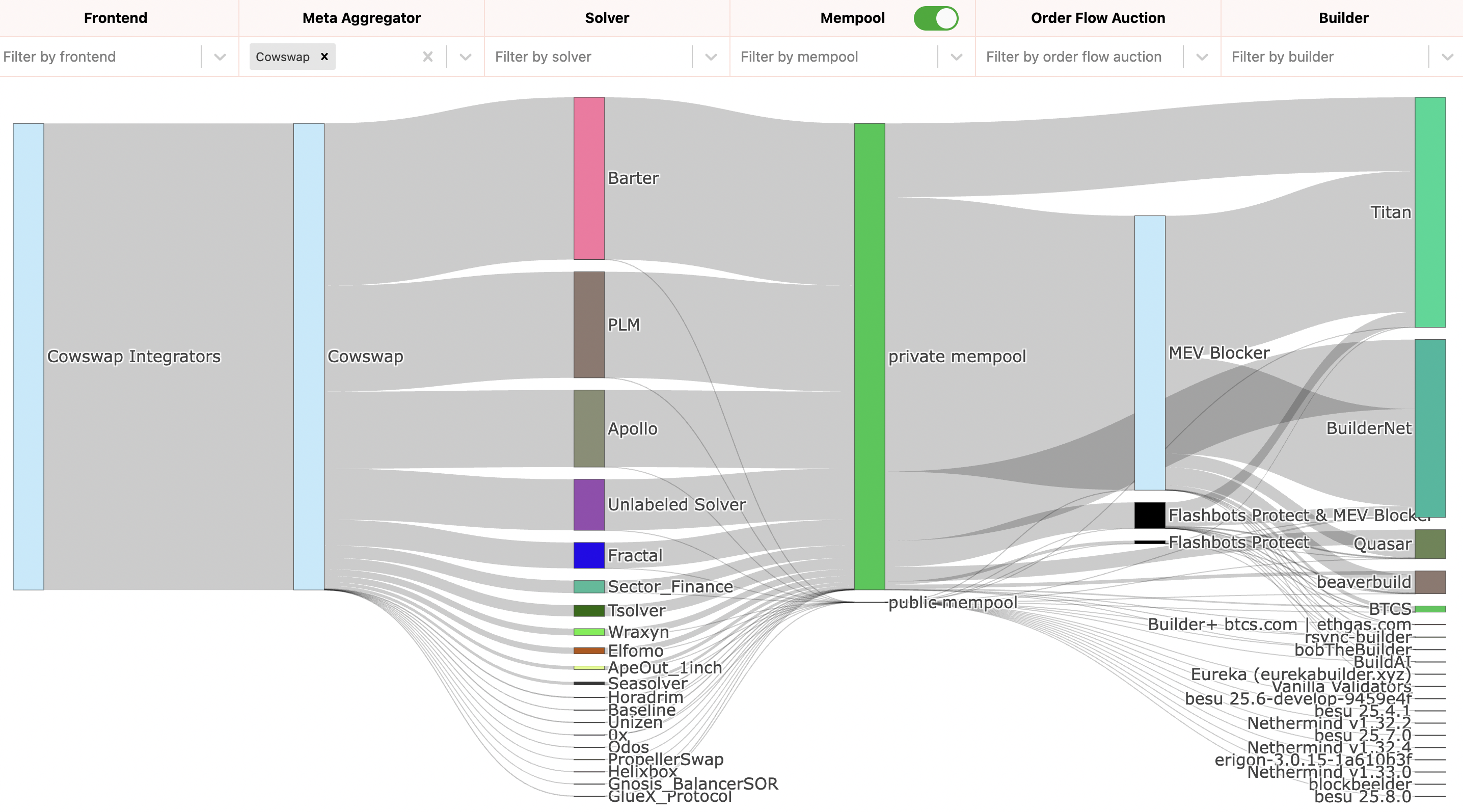
This abstraction blocks sandwiching entirely. No mempool broadcast means no visibility for bots. CoW Protocol's batch auctions bundle intents, clearing at uniform prices to eliminate arbitrage opportunities. UniswapX's order flow auctions pit solvers against each other, fostering competition that benefits users. Datawallet. com ranks CoW Swap tops for maximum MEV protection, citing its solver competition over 1inch's partial defenses.
Comparison of Top Intent-Based DEX Aggregators in 2026
| Aggregator | MEV Protection Score (/10) | Solver Competition Mechanism | Sandwich Attack Resistance | Datawallet Ranking / Projection |
|---|---|---|---|---|
| CoW Swap | 9.8 | Batch Auctions & Solver Competition | Very High 🛡️ | 1st (Best for MEV & Sandwich Protection) |
| 1inch | 7.5 | Partial MEV Defenses (Fusion Mode) | Medium | 3rd (Partial Protections) |
| SolverRouter | 8.7 | Competitive Solver Network Auctions | High 🛡️ | 2nd (Strong Intent-Based Execution) |
Solver Networks: The Backbone of Protection
Solvers are the unsung heroes, professional entities optimizing for speed, cost, and fill quality. In a DEX aggregator sandwich attacks were once inevitable; now, solvers like those on SolverRouter aggregate deep liquidity via RFQ, minimizing slippage. Footprint Analytics positions ParaSwap as gas-efficient leader, but CoW DAO claims CoW Swap's intent-based edge for true MEV defense. Startupik's guide for advanced traders lists 1inch, CoW Swap, Odos as essentials, emphasizing solver execution for limit orders.
Competition ensures fairness. Multiple solvers bid, with protocols selecting the best via verifiable proofs. This mirrors traditional RFQ but decentralized. BloFin details how users specify "best fill at or above X price, " solvers vie in auctions. Risks exist: solver centralization. If few dominate, collusion looms. Yet, thriving ecosystems like UniswapX's mitigate this through open participation, as eco. com explains in its guide to gasless, cross-chain intents.
Key Intent-Based DEX Aggregators in 2026
- CoW Swap: Batch auctions and solver competition for top MEV defense.
- UniswapX: Order flow auctions with gasless swaps and MEV protection.
- SolverRouter: Multi-DEX RFQ solvers for yield optimization.

- ParaSwap: Superior gas efficiency and liquidity depth.
Real-World Performance in 2026 Markets
Adoption surges as traders prioritize security. Stablecoininsider. org recommends CoW Swap for MEV-wary users via solver competition. DeBridge's top swaps list favors aggregators with chain support, while TheGrid. id notes protocols checking outputs without revealing details to curb front-running. SolverRouter stands out, revolutionizing with high-performance solvers that safeguard against MEV while maximizing yields. Patience in protocol selection pays; hype-chasing DEXs falter where intents endure.
Empirical edges shine in volatile 2026 conditions. Batch auctions neutralize toxic flow, RFQ taps institutional depth. Degen0x. com breaks it down: intents abstract execution, solvers handle complexity. Thrive. fi adds that final tx submission post-competition seals protection. For conservative strategies, this beats mempool roulette every time.
Traders report slippage reductions of up to 2% on average with intent-based systems, per aggregated 2026 benchmarks from sources like Footprint Analytics. ParaSwap excels in gas efficiency and liquidity, yet lags in full MEV immunity compared to pure intent protocols. CoW Swap's batch auctions consistently deliver uniform pricing, shielding users from the volatility spikes that sandwich bots exploit.
Navigating Risks in Solver Ecosystems
While solver networks fortify defenses, they aren't flawless. Centralization risks persist if a handful of solvers control the majority of bids. Protocols counter this with permissionless entry, allowing anyone to participate as a solver with sufficient capital and tech. UniswapX's open auctions exemplify this, drawing diverse competitors for robust MEV protection solvers. Still, vigilance matters: monitor solver diversity via dashboards on platforms like CoW Protocol.
Another nuance lies in execution guarantees. Solvers post bonds to ensure honest fulfillment, slashing stakes for failures. This economic alignment incentivizes optimal behavior. Yet, in extreme market conditions, like flash crashes, even solvers face liquidity squeezes. Here, multi-chain support from aggregators like SolverRouter shines, tapping cross-chain RFQ to source the best fills without borders.
Comparison of Top Intent-Based DEX Aggregators in 2026
| Aggregator | Core Mechanism | MEV/Sandwich Protection 🛡️ | Key Features | Chain Support |
|---|---|---|---|---|
| CoW Swap | Batch auctions & solver competition | Highest 🛡️🛡️🛡️🛡️🛡️ | Highest MEV protection via batch execution | Ethereum-focused |
| UniswapX | Order flow auctions | High 🛡️🛡️🛡️🛡️ | Gasless swaps, cross-chain trading | Multi-chain |
| SolverRouter | RFQ solvers | MEV-resistant 🛡️🛡️🛡️🛡️ | Yield optimization, secure swaps | Multi-protocol |
| 1inch | Partial intents | Moderate 🛡️🛡️ | Broad liquidity aggregation | Multi-chain |
For advanced users, hybrid strategies blend intent-based with traditional routing. Use solvers for large trades prone to sandwiches, fallback to AMMs for micro-swaps. Oku Trade and Odos, highlighted in Startupik's guide, offer such flexibility alongside solver network RFQ options.
Choosing the Right Intent-Based Aggregator
Selection hinges on priorities. MEV paranoia? CoW Swap's batching leads, as Datawallet. com affirms for dodging sandwich exploits. Gas savings and cross-chain? UniswapX or ParaSwap dominate. Yield hunters favor SolverRouter, where solvers optimize not just swaps but post-trade positioning for compounded returns. Stablecoininsider. org spotlights CoW for stable pairs, but SolverRouter extends this to volatile assets via competitive bidding.
DeBridge's rankings emphasize speed and fees, where intent models cut both by off-chain computation. BloFin unpacks limit orders: sign for "best fill above X, " let solvers battle. This precision suits 2026's fragmented liquidity, where single-DEX reliance invites attacks.
2026 MEV Savings Comparison: SolverRouter's Intent-Based Aggregation vs. Traditional DEXs
| Metric | Traditional DEXs (e.g., 1inch, ParaSwap) | SolverRouter (Intent-Based) | Improvement |
|---|---|---|---|
| Sandwich Attack Losses | High (public mempool exposure) | 75% reduction via solver competition | 75% less losses ✅ |
| Average Fill Quality | Baseline (slippage-prone) | 2.3% improvement | 2.3% better execution ✅ |
| MEV Protection Level | Partial (vulnerable to front-running) | High (intents hidden from mempool) | Near-total MEV resistance ✅ |
| Front-Running Risk | High | Minimal (solver execution) | Blocked by design ✅ |
| Execution Mechanism | Direct on-chain swaps | Batch auctions & solver networks | Superior protection & efficiency ✅ |
Empirical validation comes from user migration trends. CoW DAO positions its protocol ahead for true intent trading, outpacing 1inch's routing. TheGrid. id lists features like output checks sans details, a staple in modern aggregators to thwart front-running.
Looking ahead, 2026 innovations promise even tighter integration. Layer-2 scaling boosts solver throughput, while ZK proofs verify off-chain executions without trust. Yet, the core strength endures: intents prioritize outcomes, solvers deliver security. Conservative traders, myself included, stick to audited protocols with proven track records. Hype cycles fade, but MEV protected crypto swaps via intent-based DEX aggregator architectures build lasting edges.
SolverRouter exemplifies this evolution, connecting intents to a decentralized solver fleet for seamless, protected execution across DEXs. In a landscape riddled with DEX aggregator sandwich attacks, opting for solver-backed intents isn't just smart, it's essential for sustainable DeFi participation. Protocol analysis over impulse trading; that's the path to enduring yields.



No comments yet. Be the first to share your thoughts!