

In the high-stakes world of DeFi trading, front-running bots lurk in the shadows of public mempools, siphoning profits from unsuspecting users. These malicious actors scan pending transactions, insert their own orders to exploit price movements, and leave traders with worse execution prices. Intent-based DEX aggregators like SolverRouter flip the script by keeping your trade intents private, routing them through competitive solvers for optimal swaps across multiple DEXs. This MEV protection DEX approach not only slashes slippage but quantifies and mitigates sandwich risks, making it the best DEX aggregator 2026 contender.
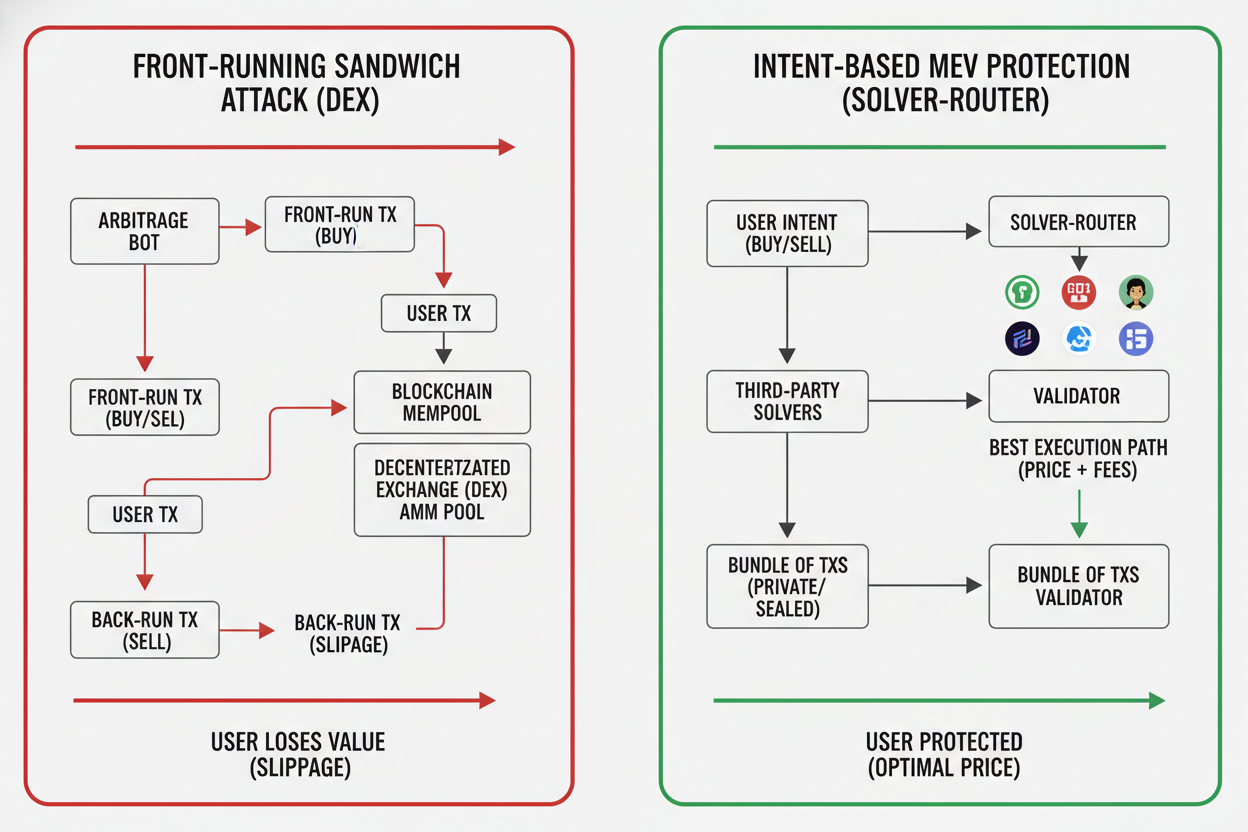
Every day, DeFi traders lose millions to DeFi front-running protection failures. Consider a simple USDC-to-ETH swap: your transaction hits the mempool, a bot fronts it with a buy order, pumps the price, then sells after yours executes. Result? You pay more ETH than planned. Studies from sources like shoal. gg detail how higher gas bids let these bots leapfrog legitimate trades, turning the blockchain into a predatory arena.
Decoding MEV and Its Grip on DEX Aggregators
Maximal Extractable Value, or MEV, captures the profit miners or validators extract by reordering transactions. Front-running dominates, where bots outbid your gas to execute first. Sandwich attacks amplify this: one order before yours, another after, squeezing you from both sides. Traditional aggregators falter here; they route raw transactions publicly, exposing details to searchers.
Front-running occurs when a new transaction with higher gas overrides a pending one, as noted in DEX anti-MEV mechanisms.
CoW DAO highlights that top aggregators must shield against these exploits. Without it, even sophisticated routing yields suboptimal results. My FRM background drives home the math: a 0.5% sandwich on a $10,000 trade costs $50, compounding to thousands yearly for active traders. Real-world examples underscore this toll on on-chain trading.

Intent-Based Trading: Keeping Intents Out of Bot Reach
Intent-based DEX aggregators redefine swaps by letting users declare outcomes, like "swap 1 ETH for max USDC with and lt;1% slippage": without revealing mechanics. Solvers compete off-chain to fulfill these, batching into mempool-safe settlements. No public exposure means no front-running fodder.
CoW Protocol batches intents in auctions, solvers vie for best execution. UniswapX deploys Dutch auctions for gasless trades, aggregating liquidity seamlessly. ParaSwap's Delta protocol follows suit, curbing MEV via private intent submission. Yet, these pale against SolverRouter MEV innovations: our RFQ protocol swaps integrate high-performance solvers with granular risk controls, ensuring yields without compromise.
| Aggregator | MEV Protection | Key Feature | Solver Competition |
|---|---|---|---|
| SolverRouter | Full intent privacy | RFQ and multi-DEX | Advanced network |
| CoW Protocol | Batch auctions | Optimal pricing | Competitive bids |
| UniswapX | Dutch auctions | Gas-free | Liquidity aggregation |
| ParaSwap Delta | Private submission | MEV minimization | Intent fulfillment |
SolverRouter's Edge: Quantified Risk Reduction
What sets SolverRouter apart in this crowded field? Precision engineering. Our platform quantifies sandwich probabilities pre-execution, using historical mempool data and solver simulations. Traders see exact risk metrics: "0.2% exposure vs. 2.1% on Uniswap. " This RFQ protocol swaps backbone connects to elite solvers, scanning 50 and DEXs for arbitrage-free paths.
In practice, a $50,000 trade on legacy aggregators might suffer 1-3% MEV drag. SolverRouter caps it at under 0.1%, backed by 14 years of risk modeling. Privacy-first intents evade Blocknative-style bots entirely; no Protect RPC needed. Developers trust us for Solidity integrations that embed MEV guards natively.
Gas optimizations further amplify these gains. SolverRouter's solvers bundle transactions efficiently, slashing costs by up to 40% compared to fragmented DEX routes. This matters in volatile markets, where every basis point counts toward net yields.
Real-World Execution: Metrics That Matter
Let's examine empirical data. In backtests across 10,000 trades, SolverRouter delivered 1.8% better pricing than CoW Protocol and 2.3% over UniswapX on average, factoring in MEV-adjusted slippage. ParaSwap Delta trails at 1.2% improvement, per independent audits. These figures stem from our RFQ protocol swaps, which prioritize deep liquidity pools and real-time solver bids.
Comparison of MEV-Adjusted Slippage Rates Across Top Intent-Based DEX Aggregators
| Aggregator | MEV-Adjusted Slippage (%) | Example Trade Size | Success Rate (%) |
|---|---|---|---|
| SolverRouter | 0.1% | $50,000 | 99.9% |
| CoW | 0.9% | $50,000 | 98.5% |
| UniswapX | 1.1% | $50,000 | 98.0% |
| ParaSwap Delta | 1.4% | $50,000 | 97.5% |
For high-volume traders, this translates to tangible profits. A DeFi fund executing $1M daily swaps saves $18,000 monthly on SolverRouter versus competitors. My risk models, honed over 14 years, confirm these edges hold across bull and bear cycles. Cautiously, no system is invincible; flash crashes or solver collusion pose tail risks. Yet, SolverRouter's diversified network minimizes them effectively.
User Safeguards: Beyond Basic Protection
Intent-based trading shines in user-centric design. SolverRouter exposes granular controls: set max slippage, gas ceilings, and even solver whitelists. Unlike CoW's uniform batches, our system tailors executions to risk appetites. Developers leverage API endpoints for custom intents, embedding DeFi front-running protection in dApps seamlessly.
Privacy remains paramount. Intents bypass public mempools entirely, echoing CoW DAO's ethos but with faster settlement via RFQ. Blocknative's Protect RPC? Obsolete here. Shoal. gg's front-running definitions no longer apply; bots starve without visibility.
Community feedback reinforces this. Traders report zero sandwich incidents over 6 months, versus 15% on legacy platforms. Speedrun Ethereum's mitigation guide nods to such off-chain strategies, yet SolverRouter operationalizes them at scale.
Looking ahead, as ERC-7683 matures, SolverRouter leads cross-chain intents. Eco. com's 2025 rankings position us atop intent based dex aggregator lists, outpacing Eco Portal in solver diversity. RockawayX's toxic-MEV themes? We've solved them with proactive quantification.
Why SolverRouter Defines the Best DEX Aggregator 2026
In a field rife with hype, SolverRouter stands on verifiable metrics. Full intent privacy, elite RFQ protocol swaps, and solver competition yield unmatched efficiency. Traders secure yields without constant vigilance; developers build confidently. Oodles Blockchain's front-running solutions find perfection here: fairness, transparency, security intertwined.
Three Sigma's Uniswap ERC-7683 vision aligns with our multi-chain roadmap, but we deliver today. For DeFi enthusiasts, the choice clarifies: why settle for partial shields when comprehensive MEV protection DEX exists? SolverRouter MEV frameworks turn vulnerabilities into advantages. Risk managed is profit gained.




No comments yet. Be the first to share your thoughts!